
Two Concepts of Markets
A camera or an engine?

When a market sets a price on something, is it telling us what the thing is worth, or helping to decide it? The question sounds technical. It turns out to be a question about freedom.
I have been slowly making my way through Louis Menand’s The Free World. The book covers art and thought during the early years of the Cold War, when the US was moving towards the center of an increasingly international cultural scene. The book’s chapter on liberty centers around Isaiah Berlin and his famous speech popularizing the difference between negative freedom (freedom from interference) and positive liberty (freedom to realize some end).
These two conceptions of liberty inspire two conceptions of markets. One read is that the market is a camera, revealing underlying preferences. Price is a faithful compression, folding into a single number many different underlying valuations: what a thing costs to make, what it is worth to whoever wants it and for whatever reason, what it might yet become, and the discount for the risk and the waiting of holding it. One number, many meanings, all in the eye of the beholder. This is Hayek’s market, negative freedom made concrete: knowledge scattered across millions of people, imposing no ends, with the price assembling all these private valuations into a public signal.
Some would argue that the market is not a camera, but an engine.
Prediction markets
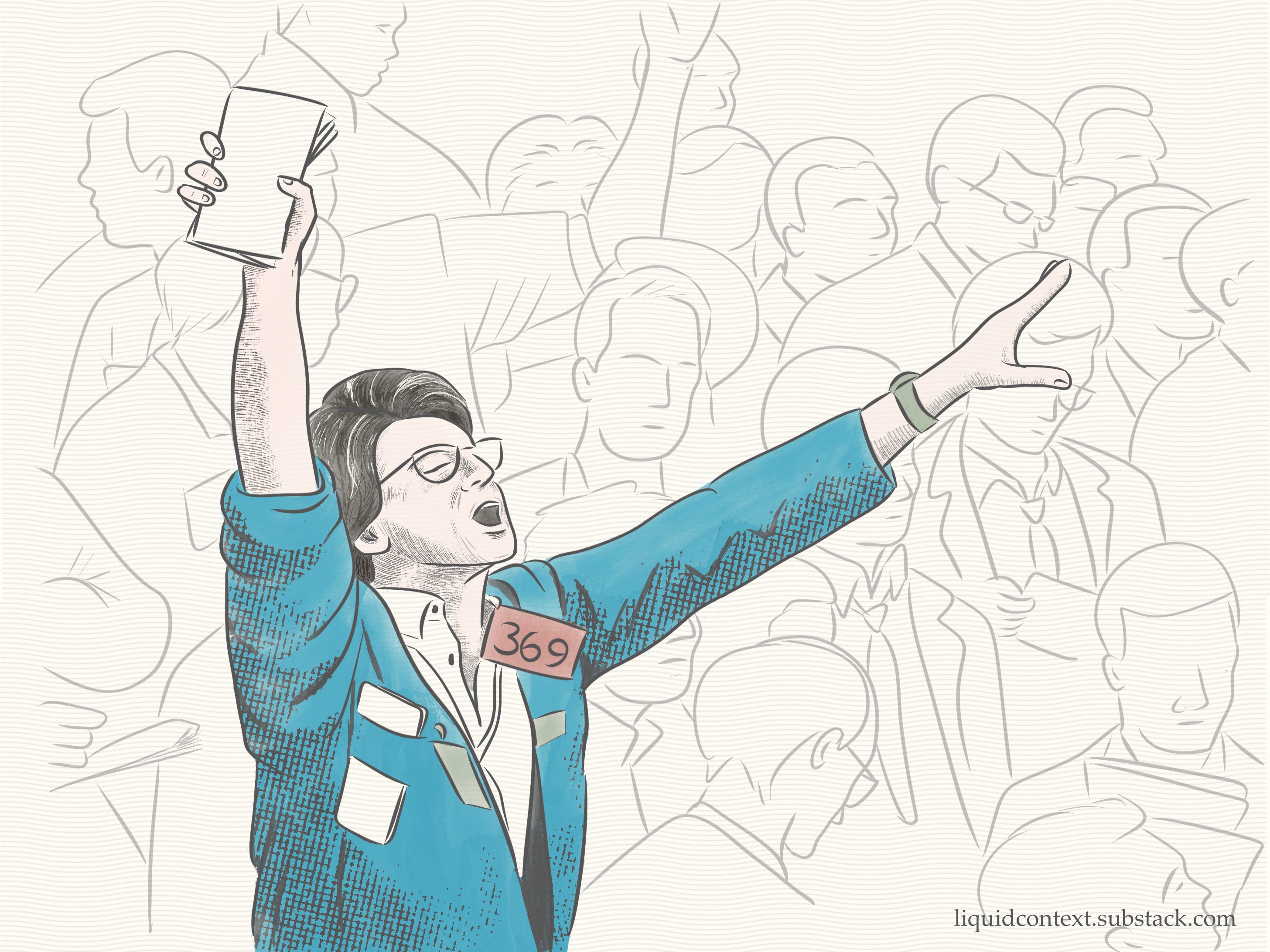
Prediction markets make for an interesting live case study. Organized betting on outcomes dates back more than a century. Economists have documented that New York, from the 1880s through the 1940s, had large, liquid election betting on the curbs of downtown Manhattan, in the space that would eventually become the American Stock Exchange. University of Iowa’s business school began a more deliberate academic version in 1988, running the Iowa Electronic Markets as a real-money research platform. A 2008 paper found that the Iowa markets beat election polls more often than not across decades.
Prediction markets sat in a legal grey zone - regulated financial contracts, or just gambling? - which kept them small and, in Polymarket’s case, offshore. The CFTC tried to block Kalshi from listing contracts on which party would control Congress, calling election betting a form of gaming against the public interest. Kalshi sued and in late 2024, a federal court ruled in Kalshi’s favor. This paved the way for greater legal certainty and Polymarket and Kalshi have grown tremendously. Trading volume went from a few million in 2023 to a combined $24 billion in April 2026, trading in a month roughly the NFL’s entire annual revenue.
By Pew Research’s accounting, sports, crypto and politics are the markets with the highest volumes, although the share of these markets vary across the two platforms. Kalshi trading volumes are 80% sports, 7% crypto and 4% politics, while the respective split is 39%, 20% and 32% for Polymarket. The mix may prove seasonal. In the weeks around the 2024 presidential vote, politics was roughly two-thirds of Polymarket’s volume and 90% of Kalshi’s (but this was also before it offered sports).
Who pays for accuracy?
A recent working paper investigates prediction market accuracy. They show prices closely track outcomes: a contract priced near 70% resolves yes about 70% of the time. This accuracy appears driven by fewer than three percent of accounts, who are skilled traders. These accounts are skilled in a specific, testable sense: the researchers split each trader’s record in two and asked whether early success predicted later success. Lucky winners’ success fades, while the skilled keep winning.
This points to a different mechanism for accuracy than most people’s intuition. It is not “wisdom of the crowds,” where the average of enough independent guesses can cancel out errors. This is more “wisdom of the specialists”, as accuracy depends on those accounts rather than being the average of many decent guesses. It is also not insider trading. The paper flags accounts whose wins cluster in a single market just before the news breaks. The skilled win across many dispersed, unrelated markets, suggesting a general craft rather than private tips.
Most of the volume is generated by users who perform no better than chance. Economists decades ago (specifically Grossman and Stiglitz in 1980) argued that a market’s efficiency needs to be paid for by someone. The move towards efficiency happens only because the informed can profit, and that profit comes from those who trade without information. The 97% supply most of the volume and almost none of the information, and their losses make up the informed minority’s profit.
If everyone can benefit from accurate prices, to what extent does it matter who pays for this discovery?
One answer is that it doesn’t matter at all: a price should be judged by whether it works, not by how it is made or who pays for it. In a highly influential paper, The Methodology of Positive Economics, Milton Friedman argued that a theory’s assumptions don’t need to be realistic as long as they are predictive. This 1953 paper became one of the most cited and most debated papers on economics methodology, as it also draws the line between positive economics (the study of what is) and normative economics (the study of what ought to be). Positive economics asks what will happen, and Friedman’s claim was that such a science should be judged on one thing only: whether its predictions come true.
But if time runs only one way, if an event happens once and cannot be replayed, what does it mean for a price to be predictive?
Making a trade
A price is ultimately about a buyer and seller finding each other. Part of the role of the market is to facilitate this moment, where buyer and seller meet. But that perfect coincidence does not happen easily, as a price needs a buyer and a seller to want the opposite things at the same instant.
To allow for immediacy, someone (or something) needs to hold inventory. This is true of supermarkets, this is true of financial markets. This is what it means to be a “dealer” in financial markets: to be in the business of allowing immediacy of that exchange. Prices are “made” by the dealer, who stands ready to either buy or sell to anyone. A supermarket holds inventory so you don’t need to go find a farmer; a bond dealer holds bonds; a bank, in a sense, holds money, standing ready to turn a deposit into cash.
Many market participants prefer to be “price takers,” accepting prices on offer rather than posting one of their own. A resting quote is itself a signal: an investor with conviction would rather take an offer than announce one, since a public quote is easier to pick off once it goes stale. Even on an electronic exchange, an order has to be posted before it can be matched. Prices are “made” by the dealer, who quotes the prices they stand ready to buy or sell.
A dealer is not really wagering on what the inventory is ultimately worth; but on the ability to pass it on quickly, near the price paid. To hold inventory is to hold the risk that it goes bad: that the price moves against the dealer before they can offload it, leaving them to sell for less than what they paid. So the dealer watches flow rather than fundamentals: whether buyers or sellers are crowding in, whether there’s more people wanting to buy vs. wanting to sell. There is also the risk of trading with the informed: that whoever just took the quote might know something about where the market is going.
This standing ready and offering immediacy of trade is a valuable service. The dealer earns by buying a little below and selling a little above the going price, so that the steady stream of ordinary traders pays a small toll that covers the occasional one who picks the dealer off. When the flow starts to look one-sided, all buyers and no sellers, the dealer widens that gap or steps back.
Holding inventory leaves the dealer exposed, and her main defense is to hedge: to hold something that moves opposite to what she’s carrying, so a loss on one side is a gain on the other. Whether she can hedge at all depends on what she’s holding. In “Predicting our own demise,” former Jane Street trader Agustin Lebron argues that prediction markets have a structural weakness in allowing hedging. Most prediction contracts are binary, and a binary gives the dealer nothing to offset the risk of making that market.
Consider an ordinary dealer who has just sold someone a bet that oil will rise. She is exposed: if oil rises, she pays out. But oil is a real thing in the world, so she can protect herself by holding some: now if oil rises she loses on the bet and gains on what she holds, and the two cancel, leaving her only her small fee and indifferent to where oil actually goes. In practice, she holds a futures contract tied to the price rather than barrels in a tank. A dealer who has sold a bet on an election can do nothing of the kind. There is nothing in the world that rises and falls with “this candidate wins,” no half-election to hold against it, so she is stuck carrying the whole risk, winning big or losing big when it settles. Because she cannot lay the risk off, she mostly stays away, and the market stays thin.
Making a price
Lebron’s other reason for skepticism attacks the view of markets as a camera. A prediction market contract settles when the event happens or doesn’t. The question becomes whether that settling reality sits beyond reach or within it.
There are markets where it is impossible for the market itself to impact the underlying goods being traded. Take for example, a prediction market on the chances of solar radiation. No matter how frenzied the market becomes, no trader can reach up and change the sun.1 Something either comes true or it does not, and the contract settles against that reality: so the price has a hard anchor it cannot move, and if it is accurate, it really did see the world coming. Accuracy here means discovery.
At the other hand of the spectrum, if what settles the bet is within reach, incentives can change from truth-seeking to truth-making. This is the concept of reflexivity: the participants’ view of a market reaches back and changes the market itself. It’s Schrödinger’s market: the act of measuring alters the thing measured. This is a concern well known to regulators in traditional markets: short-sellers will release news of the firm they are betting against to help push prices under. This practice is old enough that regulators have built rules against this since the 1930s.
Prediction markets expand the risk that the world will be tampered with, in order to fulfill the contract. One trader turned $119 into more than $21,000 on the high temperature at Charles de Gaulle. No neighboring station had recorded a similar spike in temperature and the French police are investigating potential sensor tampering. The risk reaches even the machinery that judges the market. Polymarket settles disputed markets through a “decentralized oracle,” where outcomes can be resolved through voting. In March 2025, a $7 million market on whether Ukraine would sign Trump’s mineral deal had its oracle resolve the bet as “yes” despite no deal being signed. One holder cast about a quarter of the votes across three accounts, voting his position on the mineral deal into victory. Polymarket called it “unprecedented” but kept the result.
The bigger concern is not just that prices are tampered with, but that they become self-fulfilling. If campaigns and donors and the press treat the odds as the truth and act on them, moving money and attention accordingly, the forecast helps bring about the outcome simply by being believed. This makes the forecast “accurate,” but less from discovery than by creation.
Making a market
While reflexivity is about self-fulfilling prices, sociologist Donald MacKenzie calls out the risk of self-fulfilling theory. In An Engine, Not a Camera,2 MacKenzie investigates how models of option pricing, once adopted by traders, drew prices towards their own shape. The theory became true because everyone treated it as true. (The fit later broke down, which is part of his point: a theory makes itself true for a time, then ceases to as the world further changes.) A market is not found and described. It is built. It coordinates expectations, behavior and action, helping bring about what was once only predicted.
A market that can reach its own outcome does more than leave us alone: in helping to make the result, it shapes what we end up wanting and getting. That is closer to positive liberty, the freedom to realize an end. Berlin distrusted “freedom to” because of how easily it became a rationale for coercion: once someone fixes what your real self ought to want, they may feel entitled to move you toward it. Treat the price as the authority on value and it can have a similar effect.
Berlin traced the idea of a self that is authored rather than inherited to Romanticism: the European movement in the late eighteenth and early nineteenth centuries that broke with the Enlightenment’s confidence in a single given order. Where earlier thought had treated the self as something to be discovered, a nature to be understood and lived in accordance with. The Romantics treated it as something to be created, authored by the will rather than found in the world. People gained the dignity of making a life rather than conforming to a given one. But then something was also lost: a fixed standard against which a choice could be called true or mistaken.
A price offers itself as that lost standard restored: the measure that can hold every competing want at once. Berlin also notes that the ends we care about are necessarily incommensurable: to have more of one we give up some of another, and no measure carries them all without loss. Liberty is liberty, not justice or happiness. A price is a price: not worth, not truth, only the number a buyer and a seller will meet at.
Building a market can read as an exercise of freedom, the freedom to bring something into being; walling one off can read as coercion, a freedom taken away. Writing in the early 1940s, the philosopher Simone Weil asked whether talk of obligations should have come before talk of rights. A right can present itself as a natural fact, something owed to us simply because we exist. That hides what it takes to make the right a reality, and the work each of us has to put in for each other. Prices similarly arrive as a plain fact, while hiding the commitments that sustain them: the dealer carrying the risk to provide immediacy, the losses that pay for accuracy, the belief that makes the outcome real.
What we are willing to settle by price, and what we are not, is the one judgment no price can make for us. It would be easier if coordination were automatic, our competing wants reconciled by a price rather than by argument, negative freedom left wholly intact. But coordination was never quite costless, and we were never quite so separate from one another as it implied. A camera records the world as it found it. An engine does work, and someone must build it, fuel it, and answer for what it makes.
One would like this to be true of sports as well, but alas
The title of his book is itself an inversion of a quote in Friedman’s paper
How do you think about the economic efficiency of the price mechanism across different types of markets? By that I mean, are Schrödinger markets less efficient because of market manipulation in favor of the traders who win those markets? Are other markets more efficient? I guess efficiency isn’t a term you really talk through here so maybe we need to define the term.